Three more tests of India’s ICBM in 12 months
Published April 19, 2015 | By admin
SOURCE : IANS
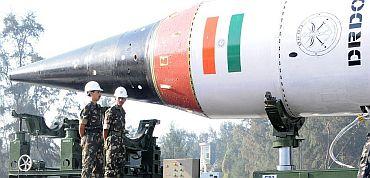
The more tests will be conducted in the next 12 months of India’s indigenously-developed nuclear-capable Agni-V inter-continental ballistic missile, which can reach targets as far as Beijing, before it would be “ready for induction”, its developer says.
“We need to do two to three more development launches and the forces may want to do some. We expect by mid-2016, the missile will be ready for induction,” an official of the Defence Research and Development Organisation (DRDO), which has developed the missile, told IANS on condition of anonymity as he is not authorised to speak to the media.
The jury, however, is out on that one as the 5,000-km-range missile that can carry a one-tonne warhead has repeatedly missed its deadlines. Also, “ready for induction” could be a case of semantics as the armed forces could well interpret this as “ready for user trials”, which can be quite prolonged.
The missile has already undergone three tests, the last one being from a canister.
According to DRDO officials aware about the developments concerning the missile, two to three more tests will be undertaken in the next 12 months.
The Agni-5 has been tested thrice so far.
It was first tested in April 2012 and then in September 2013. The third launch, on January 31, was from a mobile canister.
The canisterised missile has a much longer shelf-life, with the container being made of special steel that absorbs the blast of the takeoff.
In the canisterised launch, a gas generator inside the canister ejects the missile up to a height of about 30 metres. A motor is then ignited to fire the missile.
As the launch process happens inside a canister, it takes away the need of a jet deflector on the launcher that is otherwise needed for redirecting the high energy exhaust.
The strength of the surface of the launch pad is not a critical factor either, making it possible to launch the missile from anywhere.
In addition to giving the user more flexibility, a canister-based missile offers the option to launch at a very short notice and with less manpower.
“The last launch was the smoothest so far… there were no glitches and the whole process was finished in around two and half hours,” the official said.
The canisterised launch of Agni-5 was done under former DRDO chief Avinash Chander, widely known as the man behind the Agni series of missiles, on the last day of his tenure.
The Agni-5 is the most advanced version of the Agni, or Fire, series, part of the Integrated Guided Missile Development Programme that started in the 1960s. |
|



 发表于 2015-4-19 20:29

 QQ好友和群
 QQ空间
 腾讯微博
 腾讯朋友
 收藏